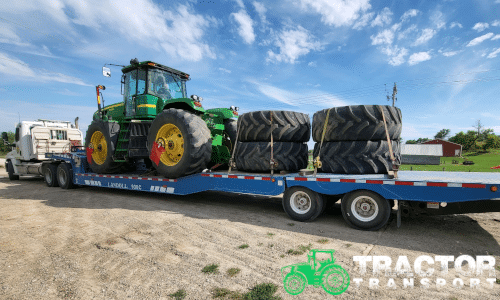
Farming Equipment in a field

The Daily Bale

The First Combine Harvester

Speak To A Live Specialist

16+
Years of Experience
A+ Rated
BBB Accredited
125+
Farm Transport Specialists
16+
Years of Experience
A+ Rated
BBB Accredited
125+
Farm Transport Specialists
Blog Home / The First Combine Harvester
Combine harvester manufacturing in the U.S. is currently worth $2 billion yearly, and there are over 30 major manufacturers. The companies with the largest market share in North America include:
  • John Deere
  • AGCO
  • Case IH
  • CNH Industrial NV
  • New Holland
  • Massey Ferguson
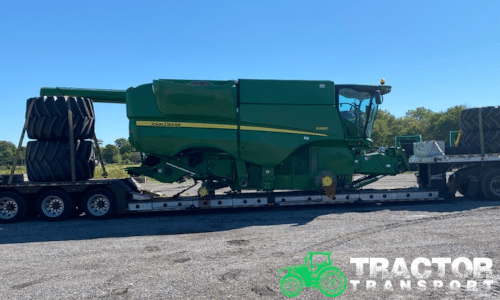
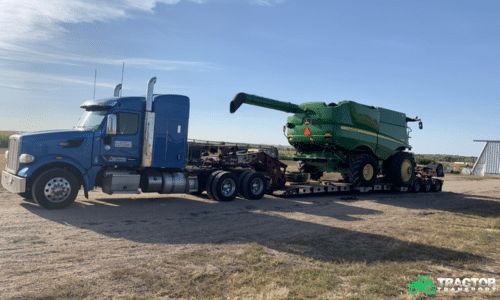
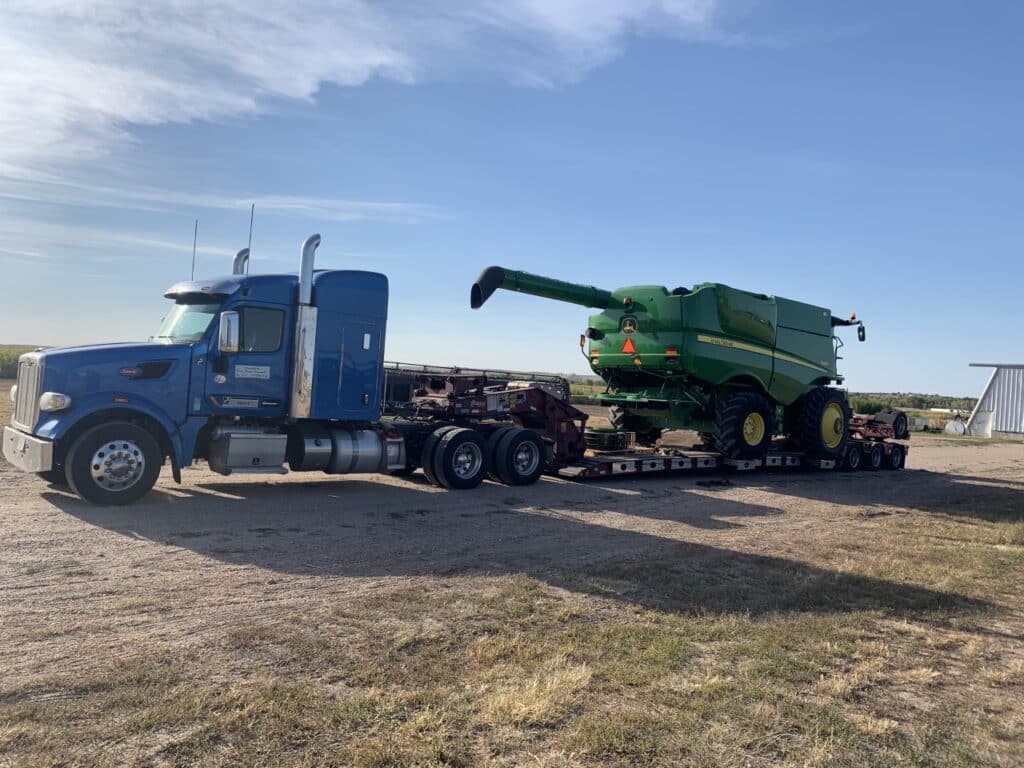
John Deere Combine loaded for transport on a lowboy trailer

The history of the combine harvester in the U.S. starts with Hiram Moore. In 1835, he built and patented the first of its type: a combine harvester which could reap, thresh, and winnow cereal grains. The name itself was coined because it combined these three harvesting activities into a single process. The earliest combine harvesting machinery used a bullwheel and was pulled by horses, mules, or teams of oxen. Twenty horses and farmhands handled the first version built by Hiram Moore.

Crops harvested with a combine include wheat, oats, barley, rye, maize, linseed, and soybeans. The straw left behind after the threshing and winnowing process is comprised of dried stems and leaves, which have limited nutrients. These components would then be chopped and spread over the field or baled up to provide bedding and feed supplements for livestock. As such, combine harvesters quickly became an economically important invention, making food cheaper to produce and livestock less expensive to keep.

By 1839, Hiram Moore had built a full-scale version of his initial design and harvested over 50 acres of crops. Two decades later, by 1860, combine harvesters were built with a cutting width of several meters and used more widely on American farms. A little while later, something similar happened in Australia, with Hugh Victor McKay building and developing the world’s first combine harvester in 1885.

Green Field
Tractor
Tractor Transport Logo

When You’re Ready to Ship,
We’re Ready to Help

We handle every step of your equipment transport safely, efficiently, and on schedule, so you can focus on what matters. 

Combine Harvesting Machinery of the 1900s

While first pulled by teams of horse, oxen, or mule, later, steam power was used. George Stockton Berry integrated a combine with a steam engine and used straw in the boiler. After WWII, tractor-drawn combines became much more common, as more farms started to use tractors. The first tractor-drawn combine harvesters used shakers to separate grain and chaff. Straw-walkers were used to eject the straw while retaining the harvested grain in the machine.

A gasoline engine typically powered early tractor-drawn combine harvesters, but later models incorporated PTO power. In both cases, these combines had either bags or bins that held grain safely until it was transferred to a truck or wagon for later transport.

The first self-powered harvester was built in 1911 by the Holt Manufacturing Company of California. In Australia, 1923, the Sunshine Auto Header became one of the first self-propelled, center-feeding harvesters that used a Fordson engine. Meanwhile, in Kansas, the Gleaner Manufacturing Company also patented a self-powered harvester that used a Fordson engine.

In the late 1930s, Thomas Carroll, while working for Massey-Harris, perfected a self-propelled harvester, as well as a lightweight model that gained prominence in 1940. Other inventions that helped develop the combine harvester that we know and love today include the auger invented by Lyle Yost, which made lifting grain out of a harvester a much easier task.

In Europe, the first self-propelled combine harvester was launched in 1952. By 1953, CLAAS had developed a self-powered combine harvester called Hercules, which could harvest 5 tons per day. There are many combine harvesters today that still emulate the design of the original Hercules, and they are still available with either gasoline or diesel engines.

The 1960s saw the invention of the self-cleaning rotary screen, which helped to prevent the common overheating issues with prior combine harvesting machinery. Combine harvesters would overheat as the chaff would often get clogged in the machine’s radiator, blocking the airflow needed to keep the engine cool.
Agricultural Truck

GET AN EXPERT QUOTE FOR YOUR TRACTOR SHIPPING NEEDS

Fill out the form above for a FREE quote. Call us at (877) 373-0109 to connect with a transport specialist today!

Significant Combine Harvester Machine Advancements

Another significant advancement that led to the success of combine harvesting equipment was the rotary design that was first introduced by Sperry-New Holland in 1975. In rotary combines, the grain is stripped away from the stalk when passed along a helical rotor. In prior designs, the grain would pass between rasp bars located outside of a cylinder and a concave.

Another significant advancement came in the 1980s when on-board electronics were introduced to help measure threshing efficiency. The instrument allowed operations to achieve better grain yields by optimizing ground speed and other parameters.

John Deere Combine loaded for transport
Tractor Transport Logo

America’s Trusted Farm Haulers

Safely and reliably hauling farm equipment nationwide since 2009.

Popular Articles

Tractor Hauling

We ship heavy and oversized tractors nationwide and to every state, including Alaska and Hawaii.

Trailer Shipping

We offer the best trailer to ship your farm equipment from flatbeds, RGNs, step decks, and more.

LTL Shipping

Your smaller farm equipment can share trailer space with other transports, often lessening costs.

Farming and Agriculture Transport

We offer custom farming and agriculture equipment transport solutions.

Drive-Away

A driver will get behind the wheel of your vehicle or equipment and drive it to the delivery destination.

International Transport

Ship your farm equipment to Canada or Mexico. We also offer port-to-port options for overseas shipping.