The Daily Bale
Best Trailer for Hauling a Tractor: How to Choose the Right One
Speak To A Live Specialist
Best Trailer for Hauling a Tractor: How to Choose the Right One
- 4 min read
- By: William Thomas
- Updated Sep 2026
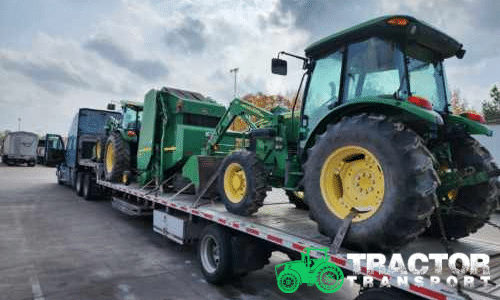
The best trailer for hauling a tractor depends on the tractor’s dimensions, weight, condition, attachments, and loading needs. A standard flatbed may work for a smaller tractor that fits within the available deck and height limits, while taller or heavier tractors often need a step deck, lowboy, or removable gooseneck (RGN) trailer.
There isn’t a single tractor hauling trailer that works for every machine. A compact tractor, a row-crop tractor with dual wheels, and a large articulated tractor can require very different equipment.
The first step is to get accurate measurements and determine how the tractor can be loaded. If you are hiring a carrier instead of hauling the equipment yourself, a tractor transport service can use these details to determine an appropriate trailer configuration.
Tractor-to-Trailer Decision Table
| Tractor or Hauling Situation | Trailer to Consider | Why It May Work |
|---|---|---|
| Smaller tractor that fits standard dimensions | Flatbed | Simple, versatile option when height, weight, and loading conditions allow |
| Taller tractor with a cab | Step deck / drop deck | Lower main deck provides additional vertical clearance |
| Tall or heavy tractor | Lowboy | Low deck helps reduce overall loaded height |
| Large tractor that can drive onto the trailer | RGN | Detachable front allows ground-level drive-on loading |
| Non-running tractor | RGN or another trailer with loading assistance | Loading method matters when the tractor cannot move under its own power |
| Extra-long tractor or tractor with equipment attached | Extended trailer configuration | Additional usable deck length may be required |
| Oversized or unusually heavy tractor | Specialized or multi-axle configuration | Dimensions, axle loading, permits, and route planning become more important |
This table is a starting point, not a substitute for matching the actual tractor to a specific trailer. Trailer configuration and usable payload can vary, so review the tractor’s exact specifications before dispatch.


When You’re Ready to Ship,
We’re Ready to Help
We handle every step of your equipment transport safely, efficiently, and on schedule, so you can focus on what matters.
What Determines the Best Trailer for Hauling a Tractor?
Four questions usually narrow the options quickly:
- How much does the tractor weigh?
- What are its transport dimensions?
- Can it be driven onto the trailer?
- Will wheels, duals, loaders, implements, or other attachments remain installed?
A tractor that looks small enough for one trailer may become an oversized load once you add dual wheels, a front loader, or another attachment.
The pickup site matters too. A trailer that works on paper still needs enough space and suitable ground conditions for the truck to enter, position for loading, and leave safely.

GET AN EXPERT QUOTE FOR YOUR TRACTOR SHIPPING NEEDS
Fill out the form above for a FREE quote. Call us at (877) 373-0109 to connect with a transport specialist today!
Flatbed Trailers for Hauling Tractors
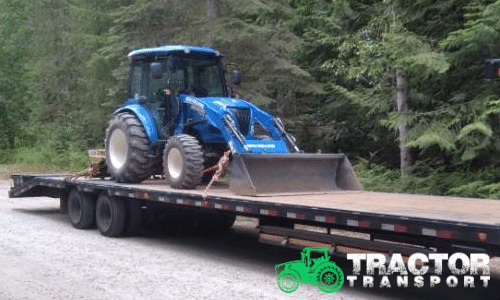
A standard flatbed is one of the simplest options when the tractor fits within the trailer’s usable dimensions and weight capacity.
Flatbeds have a straight, open deck. They provide easy side access and are commonly used for machinery that doesn’t require the extra height clearance of a lower trailer. You can learn more about typical applications on the flatbed trucking service page.
A flatbed may make sense when:
- The tractor is not excessively tall.
- Its weight fits the specific trailer’s payload limits.
- Ramps, a loading dock, crane, or other suitable loading equipment are available.
- The tractor does not require the lower deck of a step deck, lowboy, or RGN.
The biggest limitation is deck height. Putting a tall tractor on a standard flatbed increases the total loaded height, which can affect routing and trailer selection.
For that reason, measure the tractor before assuming that a flatbed is the least complicated option.
America’s Trusted Farm Haulers
Safely and reliably hauling farm equipment nationwide since 2009.
Step Deck Trailers for Taller Tractors
A step deck, also called a drop deck, has an upper deck followed by a lower main deck.
That lower deck gives a tractor more vertical clearance than it would have on a standard flatbed. This can make a step deck useful for tractors with taller cabs or other equipment that is too high for a conventional flatbed but does not require a lowboy or RGN.
A step deck may be worth considering when:
- Tractor height is the main concern.
- The machine fits the trailer’s weight capacity.
- Suitable loading equipment or ramps are available.
- Ground-level front loading is not necessary.
The lower deck can solve some height problems, but it does not automatically make a tractor legal-size. You still need to consider width, total loaded height, weight distribution, route restrictions, and state rules.
Lowboy Trailers for Large and Tall Tractors
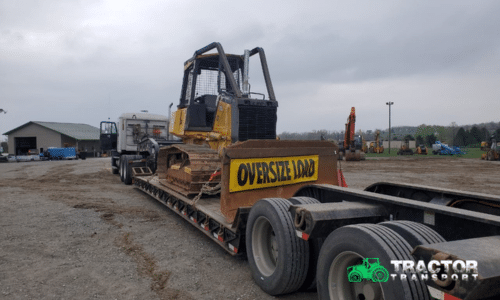
A lowboy places the main deck much closer to the road than a standard flatbed.
That makes it useful for tall tractors and other heavy agricultural machinery because the lower deck reduces overall loaded height.
A lowboy may be appropriate for:
- Large farm tractors
- Tall tractors with substantial cab height
- Heavy machinery
- Equipment that needs a lower center deck
- Loads where vertical clearance is a major consideration
Loading is an important distinction. Depending on the lowboy configuration, you may need to load the tractor from the rear, side, or with additional equipment.
That is one reason the terms lowboy and RGN should not simply be treated as interchangeable.
RGN Trailers for Large or Difficult-to-Load Tractors
An RGN, or removable gooseneck trailer, has a front section that disconnects, allowing the front of the trailer to be lowered for loading.
This creates one of the biggest advantages of an RGN: a running tractor can often be driven onto the trailer from ground level.
An RGN is especially useful when:
- The tractor is large or heavy.
- You need a low deck to control loaded height.
- Ground-level loading is preferable.
- Conventional ramps are not practical.
- The pickup location lacks a loading dock.
RGNs are commonly used for tractors and other self-propelled agricultural or construction equipment because the loading design reduces the need for separate loading infrastructure.
For especially long or heavy equipment, extended or multi-axle configurations may be considered. The trailer must still match the machine’s weight, dimensions, and axle-loading requirements.
Lowboy vs. RGN: What's the Difference?
The biggest practical difference is how the tractor gets onto the trailer.
An RGN has a removable front section. Once detached, the trailer can be lowered so compatible equipment can be driven onto the deck from the front.
A fixed-neck lowboy does not provide the same front-loading arrangement. Depending on the trailer and tractor, loading may require ramps, a loading dock, or other equipment.
Both options provide a low deck, so either may help with tall tractors. An RGN is especially useful when drive-on loading is important.
What About Gooseneck and Equipment Trailers?
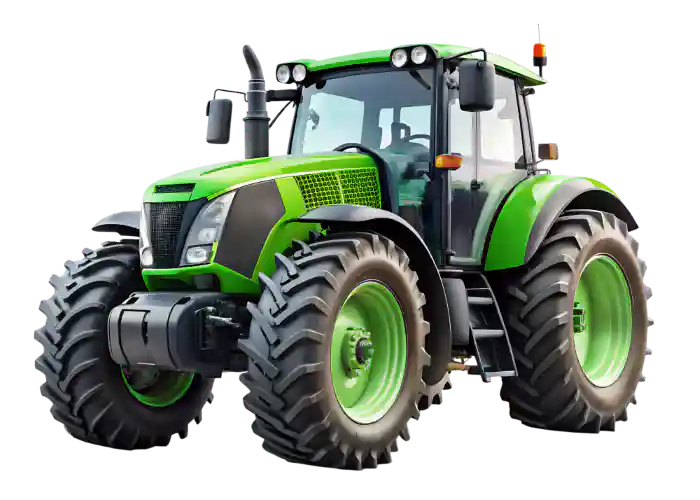
Smaller agricultural tractors can sometimes be hauled on appropriately rated equipment or gooseneck trailers.
However, just because a tractor physically fits on a trailer doesn’t mean the combination is suitable.
You still need to account for:
- Actual trailer payload rather than only its advertised GVWR
- Tow-vehicle capacity
- Axle and tire ratings
- Tongue or pin weight
- Braking requirements
- Tractor width
- Loaded height
- Proper weight distribution
- Securement
For commercial or long-distance tractor hauling, the complete truck-and-trailer configuration must be appropriate for the machine and route.
Measure Your Tractor Before Choosing a Trailer
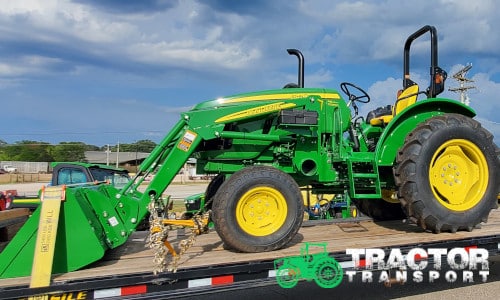
Accurate dimensions prevent many trailer-selection problems. Measure the tractor in its transport configuration, not just according to a manufacturer’s base specifications.
Provide:
Measure from the forward-most point to the rear-most point of the tractor as it will travel. Include attachments that will stay installed.
Measure the widest point. Pay particular attention to:
- Dual tires
- Wide rear tires
- Wheel spacing
- Front loaders
- Steps
- Mirrors or components that cannot be folded
- Mounted implements
Width matters because cargo wider than standard legal limits may require oversize permitting and route planning. If the tractor exceeds normal dimensions, review the site’s oversize load transport information as part of the planning process.
Measure from the ground to the tractor’s highest fixed point. That might be the:
- Cab
- Exhaust stack
- Beacon
- ROPS
- GPS equipment
- Other roof-mounted component
Total loaded height matters because the trailer deck height is added to the tractor’s own height. That is one reason a step deck, lowboy, or RGN can be preferable to a standard flatbed for taller equipment.
Use an accurate operating or transport weight whenever possible. Do not forget equipment that changes the weight, such as:
- Wheel weights
- Ballast
- Loader assemblies
- Mounted implements
- Dual wheels
- Other accessories
Trailer selection involves more than total machine weight. Axle distribution and the complete loaded combination also matter.
Should Tractor Attachments Be Removed Before Transport?
Sometimes.
Removing an attachment can reduce width, length, height, or weight and may make a different trailer configuration practical.
Examples can include:
- Front loaders
- Buckets
- Fork attachments
- Mowers
- Blades
- Dual wheels
- Rear implements
But attachments should not automatically be removed. The decision depends on how the tractor will be loaded, how the detached equipment can be secured, and whether removing it actually improves the transport plan.
Tell the hauling company what is installed before the trailer is selected. For broader preparation, the site’s farm equipment loading and transport resources can help explain what to address before pickup.
America’s Trusted Farm Haulers
Safely and reliably hauling farm equipment nationwide since 2009.
What If the Tractor Does Not Run?
A non-running tractor changes the loading plan.
Do not assume a disabled tractor can simply be pulled onto any trailer.
The carrier needs to know:
- Whether the tractor rolls freely
- Whether it steers
- Whether the brakes release
- Whether the tires hold air
- Whether loading equipment is available at pickup
- Whether unloading equipment is available at delivery
A winch, RGN, forklift, crane, or another loading solution may be required depending on the tractor and site.
If your tractor does not run, review the site’s guide to loading and transporting non-running tractors before pickup so you can identify the required equipment in advance.
Do Oversized Tractors Need Permits?
They may.
Permit requirements depend on the complete loaded dimensions and weight, as well as the states and roads involved.
A tractor that exceeds normal width, height, length, or weight limits may require additional planning, permits, or a different trailer configuration. Route restrictions and other requirements can also vary by jurisdiction.
This is another reason to take measurements before dispatch rather than after the truck arrives.
For unusually large agricultural equipment, consider oversize load transport planning along with trailer selection.
Tractor Trailer Selection Examples
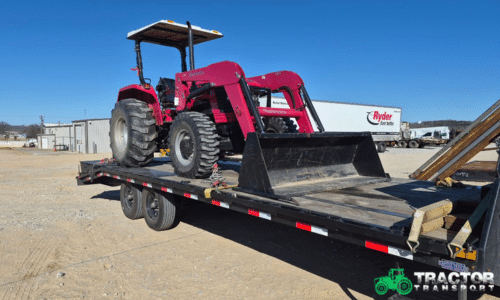
A few examples show why tractor type alone is not enough to select a trailer.
A compact tractor with modest dimensions may fit a standard flatbed or suitable equipment trailer. If you attach a front loader or mower, however, the overall length or width may change enough to affect the setup.
A row-crop tractor may not be exceptionally heavy, but dual rear wheels can make width the deciding factor. Removing the duals may sometimes change the transport plan, provided they can be transported and secured appropriately.
A cab tractor that is too tall for a flatbed may work better on a step deck, lowboy, or RGN because of the lower deck height.
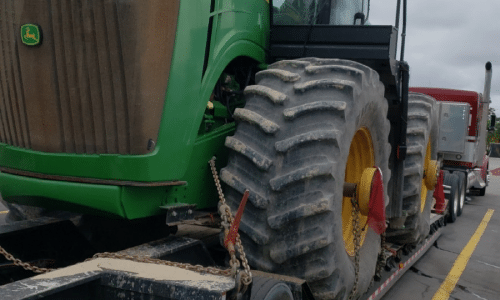
Large four-wheel-drive or articulated tractors can require a lowboy, RGN, or specialized multi-axle arrangement based on their dimensions and weight. For equipment this size, review accurate specifications before dispatching a trailer.
What Information Is Needed to Choose the Right Tractor Hauling Trailer?
Have these details ready when requesting a transport quote:
- Tractor year, make, and model
- Overall length
- Overall width
- Overall height
- Accurate weight
- Running or non-running condition
- Attachments that will remain installed
- Pickup location
- Delivery location
- Loading assistance available at pickup
- Unloading conditions at delivery
- Pickup or auction deadline, if applicable
Photos can also help identify attachments, tire configurations, clearance issues, and other details that may not be obvious from the model number alone.
Providing this information early helps the transporter match the tractor with an appropriate trailer before pickup. If you are ready to arrange the move, you can use the tractor transport service page to move from trailer research into shipment planning.
Choosing the Best Trailer for Your Tractor
The best trailer for hauling a tractor safely accommodates the machine’s actual transport dimensions, weight, loading method, and route requirements.
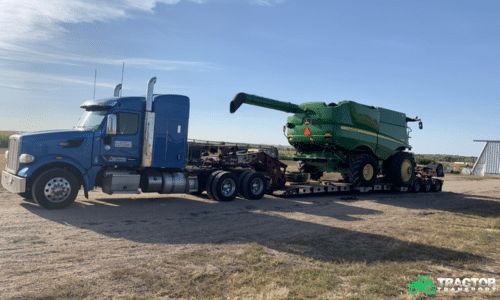
A flatbed may be sufficient for a smaller tractor. A step deck provides more vertical clearance. A lowboy works well when you need a lower deck for tall or heavy equipment. An RGN adds the advantage of ground-level front loading for many large tractors.
If you’re unsure which trailer your tractor requires, start with its make and model, dimensions, weight, running condition, pickup location, and delivery location. A tractor transport specialist can use those details to determine the right trailer configuration and flag loading or oversize considerations before scheduling the move.
America’s Trusted Farm Haulers
Safely and reliably hauling farm equipment nationwide since 2009.
Popular Articles
SERVICES
Tractor Hauling
We ship heavy and oversized tractors nationwide and to every state, including Alaska and Hawaii.
Trailer Shipping
We offer the best trailer to ship your farm equipment from flatbeds, RGNs, step decks, and more.
LTL Shipping
Your smaller farm equipment can share trailer space with other transports, often lessening costs.
Farming and Agriculture Transport
We offer custom farming and agriculture equipment transport solutions.
Drive-Away
A driver will get behind the wheel of your vehicle or equipment and drive it to the delivery destination.
International Transport
Ship your farm equipment to Canada or Mexico. We also offer port-to-port options for overseas shipping.